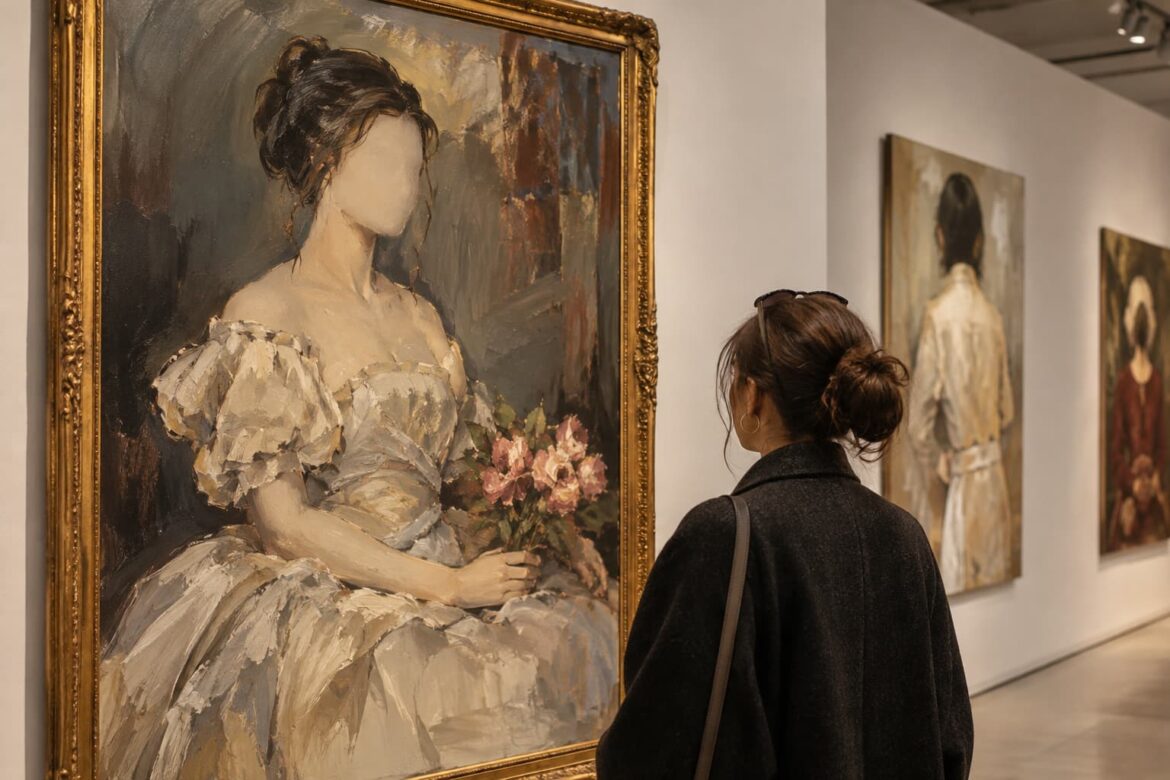
A slightly hunched shoulder, a carefully buttoned coat, or a hand resting on a chair can reveal more about a person than a detailed facial expression. Contemporary artists increasingly explore this possibility by removing, hiding, or fragmenting faces in their portraits. Instead of creating recognizable likenesses, they direct attention toward gestures, clothing, bodily presence, and the space surrounding their subjects.
This approach challenges a centuries-old assumption that the face is the primary source of personal identity in portraiture. Artists such as Gideon Rubin, Ewa Juszkiewicz, and Lorna Simpson demonstrate that an incomplete image can communicate memory, vulnerability, social identity, and emotional complexity without revealing who the subject is.
Why Remove the Face From a Portrait?
Traditional European portraiture frequently emphasized facial resemblance alongside clothing, posture, and objects that communicated wealth or status. The ability to identify the sitter was often central to the painting’s purpose. Contemporary artists working with concealed identities challenge that relationship between recognition and representation.
When facial features disappear, viewers naturally examine other visual information. The direction of a body, the position of the hands, or the tension in a figure’s shoulders becomes more noticeable. Clothing provides additional clues about historical period, social environment, and personal identity. Even the distance between a subject and the surrounding objects can suggest isolation, intimacy, or uncertainty.
The absence of a face does not necessarily make a portrait less personal. Instead, it changes how the viewer interprets the person represented. Rather than identifying someone immediately, the audience must reconstruct a possible identity from incomplete evidence.
Gideon Rubin and the Language of Forgotten Faces
London-based painter Gideon Rubin creates portraits in which facial features are deliberately omitted. His subjects often emerge from vintage photographs, historical paintings, film imagery, and popular culture. Their faces remain blank or loosely painted, while their postures and clothing retain enough detail to suggest individual lives.
Rubin frequently uses muted colors, broad brushstrokes, and partially exposed surfaces. A figure may wear a recognizable dress or jacket, but its identity remains uncertain. A slight movement of the shoulders or the position of the body becomes more important than anatomical accuracy.
This approach reflects the way personal memories often function. People may remember how someone stood, what they wore, or the atmosphere of a particular encounter while struggling to recall their facial features. Rubin transforms this incompleteness into a visual language.
His paintings also encourage viewers to contribute their own associations. A faceless child or anonymous adult can resemble someone from the observer’s past without representing that individual. The portrait becomes a meeting point between the artist’s imagery and the viewer’s memories.
Ewa Juszkiewicz and the Identity Hidden Inside Clothing
Polish artist Ewa Juszkiewicz approaches faceless portraiture through historical European painting. She recreates the elaborate dresses, hairstyles, and compositions of eighteenth- and nineteenth-century portraits, but replaces women’s faces with tightly arranged fabrics, braided hair, flowers, or vegetation.
Her paintings retain the technical refinement of traditional portraiture. Delicate lace, embroidered garments, and carefully modeled skin appear convincing, while the concealed face creates an unsettling contrast. The viewer recognizes the conventions of aristocratic portraiture but cannot establish the sitter’s individual expression.
Juszkiewicz uses this interruption to question historical expectations surrounding feminine beauty and social behavior. Formal portraits often presented women according to established ideals of elegance, modesty, and refinement. By concealing the face while preserving the costume, the artist exposes the visual conventions through which those identities were constructed.
Her 2026 exhibition at Madrid’s Museo Nacional Thyssen-Bornemisza, which ran from May 26 to September 6 and was curated by Guillermo Solana, was the artist’s first solo museum presentation. It brought together more than twenty paintings created between 2013 and the present, exploring these ideas. The presentation highlighted how the artist transforms familiar historical images into contemporary examinations of representation.
Clothing becomes the central subject rather than a decorative accessory. A carefully arranged dress no longer simply communicates wealth or taste. It reveals how social expectations can shape the appearance of the individual wearing it.
Lorna Simpson and the Fragmented Body
American artist Lorna Simpson demonstrates that facial concealment can carry a different meaning when connected to race, gender, and representation. Her photographic works frequently show subjects from behind or crop images to exclude identifying features. By separating sections of the body and combining them with text, Simpson questions how viewers interpret people through limited visual information.
In Guarded Conditions (1989), repeated photographs present a Black woman from behind, with her body divided into separate sections. The accompanying text introduces references to violence and vulnerability, complicating what might initially appear to be a neutral photographic study.
The work does not simply remove facial identity for aesthetic effect. Its fragmented presentation draws attention to the ways bodies can be observed, classified, and subjected to external judgments.
Although Simpson works primarily with photography and other media rather than conventional portrait painting, her methods have important implications for contemporary visual art. Cropping and repetition demonstrate that what an image excludes can be as significant as what it reveals.
How Posture and Clothing Replace Facial Expression
When facial features are unavailable, an artist must communicate through other elements of composition. Posture becomes particularly important because the body can suggest emotional states without explicitly describing them.
A figure leaning forward may convey attention or exhaustion, depending on the surrounding context. Crossed arms can suggest discomfort, protection, or simply a habitual resting position. These interpretations remain uncertain, which gives faceless portraits much of their psychological complexity.
Clothing introduces another layer. A formal uniform, worn coat, or elaborate historical dress can suggest occupation, economic position, cultural affiliation, or a particular moment in history. Yet such details can also mislead. Clothing may reflect social expectations rather than personal identity, a tension that Juszkiewicz examines directly.
Contemporary artists also use isolated hands, backs, necks, and partially visible bodies to challenge traditional composition. A fragment may encourage greater attention to texture, gesture, and physical presence than a complete figure would receive.
The British-Nigerian artist Yinka Shonibare explores related questions in his sculpture The Swing (after Fragonard) (2001). His headless mannequin wears an elaborate eighteenth-century-style dress made from Dutch wax-printed fabric. Without a face, the figure’s costume and posture become central to the work’s examination of cultural identity, class, and colonial history.
Why Incomplete Portraits Can Feel More Personal
A recognizable face provides information, but it can also establish distance. The viewer sees a specific individual whose identity appears complete and separate from their own experience. A faceless portrait leaves more room for uncertainty and interpretation.
This openness explains why certain anonymous figures feel unexpectedly familiar. Their gestures, clothing, and surroundings may remind viewers of relatives, strangers, or moments from their own lives. The absence of identifying features allows personal memories to influence the encounter.
However, anonymity is not always liberating. In some artworks, removing the face exposes how individuals have historically been reduced to stereotypes, social categories, or decorative figures. The meaning depends on the artist’s intentions and the wider context of the work.
Faceless portraiture therefore does more than experiment with appearance. It questions what makes a person recognizable, how identity is communicated, and how much can be understood from an incomplete image.
For contemporary artists, the face is only one element of human representation. A folded sleeve, an uncertain posture, or a partially visible hand can carry its own emotional and cultural significance. Sometimes the most revealing portrait is the one that refuses to show us everything.