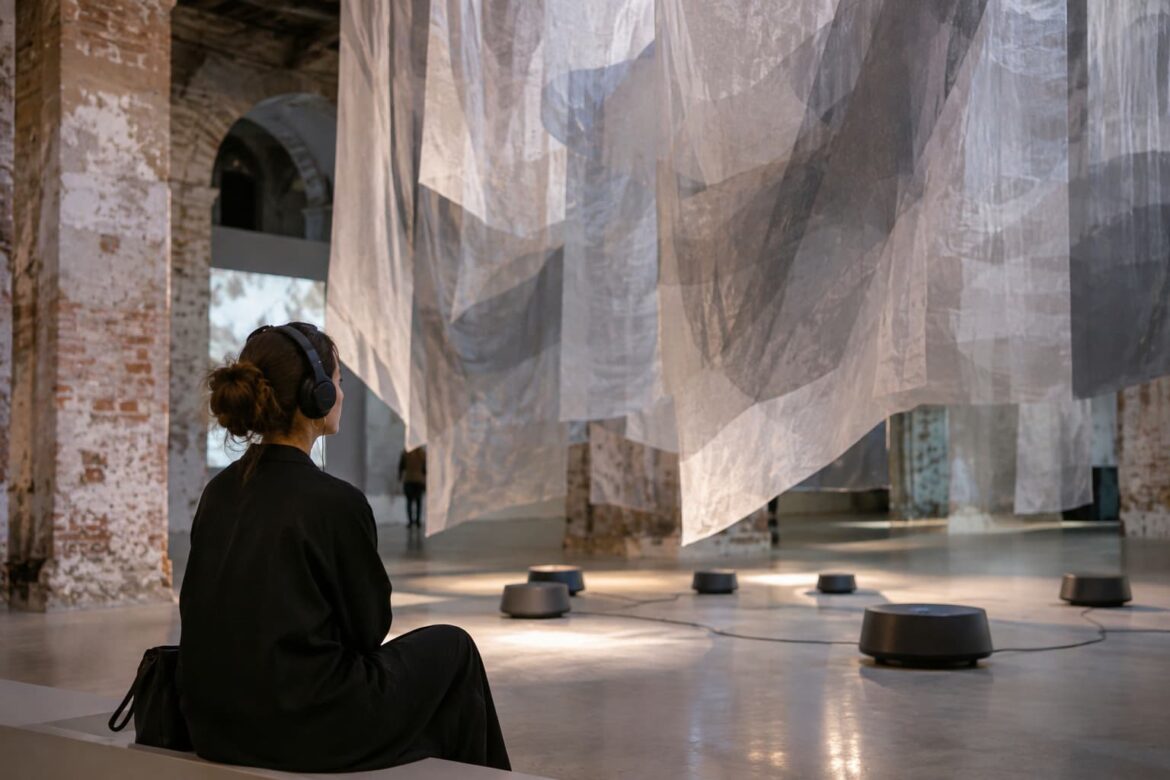
Contemporary art exhibitions often compete for attention through monumental installations, immersive projections, and increasingly elaborate technology. The 2026 Venice Biennale proposed a different approach. Instead of encouraging visitors to move quickly between spectacular works, its central exhibition invited them to slow down, notice quieter forms of expression, and reconsider what it means to experience art.
Titled In Minor Keys, the 61st International Art Exhibition ran from May 9 to November 22, 2026. Conceived by curator Koyo Kouoh, who died in May 2025, the exhibition brought together more than 100 invited artistic participants. Its central idea was that listening could become an artistic practice, not simply a response to audible sound.
What Koyo Kouoh Meant by In Minor Keys
The exhibition’s title borrowed its language from music. Minor keys are often associated with melancholy, introspection, and emotional complexity, although their expressive possibilities extend far beyond sadness. Kouoh transformed this musical reference into a curatorial philosophy centered on attention, relationships, memory, and the quieter aspects of everyday experience.
Her original statement invited visitors to breathe, relax their shoulders, and enter a slower rhythm. Rather than organize the exhibition around a single political argument or artistic movement, Kouoh envisioned interconnected spaces resembling gardens, communal gatherings, and places of refuge. Art could respond to difficult circumstances without relying exclusively on confrontation or overwhelming visual statements.
The approach did not mean that the Biennale avoided major social questions. Instead, it encouraged visitors to encounter them through experiences of care, contemplation, cultural memory, and shared presence. Listening became a metaphor for acknowledging perspectives that might otherwise disappear beneath more dominant narratives.
The Holy See Pavilion Turned a Garden Into a Sound Installation
One of the clearest expressions of this philosophy appeared in the Holy See Pavilion, titled The Ear Is the Eye of the Soul. Curated by Hans Ulrich Obrist and Ben Vickers, the project occupied two Venetian locations: the Giardino Mistico dei Carmelitani Scalzi and the Complesso di Santa Maria Ausiliatrice.
Inspired by the medieval composer and mystic Hildegard of Bingen, the pavilion explored listening as a form of contemplation. Contributors included Brian Eno, Meredith Monk, Patti Smith, Holly Herndon, Suzanne Ciani, and other musicians, artists, and writers.
At the Giardino Mistico, newly commissioned contributions from composers, poets, and artists formed a choral composition developed in collaboration with Soundwalk Collective, which captured and transformed the garden’s ambient rhythms in real time. The garden was no longer simply a location for displaying artwork. It became an active participant in the composition.
This distinction is important. Environmental sound art does not necessarily reproduce nature as people ordinarily hear it. Instead, artists may transform measurements and signals into audible information through a process known as sonification. The resulting composition reflects both natural processes and deliberate artistic interpretation.
The pavilion demonstrated how contemporary sound installations can encourage attention to details that visitors might otherwise overlook. Rather than competing with the surrounding environment, the artwork incorporated it into the experience.
Sound, Movement, and Memory Inside the Arsenale
The main exhibition also incorporated audiovisual works that used repetition, duration, and sensory immersion to alter the viewer’s perception.
At the Arsenale, Australian artist Khaled Sabsabi presented khalil, an eight-channel video installation combining moving images, audio, and scent. The work unfolded over approximately 64 minutes, creating an environment in which visitors encountered shifting visual sequences alongside an atmospheric soundtrack.
Its significance extended beyond the use of multimedia technology. Instead of delivering an instantly understandable message, the installation encouraged prolonged observation. Meaning emerged through rhythm, repeated imagery, and the relationship between different sensory elements. khalil was one of two installations by Sabsabi in Venice: he also represented Australia in its national pavilion, becoming the first Australian artist to show work in both a national pavilion and the main exhibition.
Another example was Theo Eshetu’s Garden of the Broken-Hearted, featuring an olive tree on a rotating platform accompanied by light, video, and sound. Here, movement and sound contributed to an experience of time rather than functioning merely as dramatic effects.
Such installations revealed that slowing down does not require the complete absence of technological sophistication. Advanced equipment can support contemplative experiences when the artistic purpose is carefully defined.
However, these works also exposed a tension within the exhibition. Large installations, overlapping sounds, and multiple sensory effects could occasionally produce the very intensity that the curatorial theme appeared to resist.
When Painting Becomes a Form of Listening
Not every interpretation of In Minor Keys depended on audible sound. The San Marino Pavilion, titled Sea of Sound, presented paintings by Mark Francis that explored connections between visual rhythm and acoustic sensation.
Francis’s abstract compositions evoke vibration, movement, and frequencies through repeated forms and relationships between colors. Rather than producing actual musical notes, the paintings encourage viewers to imagine a connection between what they see and what they might hear.
This approach relates to synaesthetic artistic practices, in which different sensory experiences become conceptually intertwined. A sequence of colors may suggest rhythm, while repeated shapes can establish visual patterns resembling musical structures.
For contemporary painting, the implications are significant. A canvas does not need speakers or digital components to investigate listening. Its arrangement of colors, textures, and intervals can encourage a slower process of interpretation.
The viewer becomes attentive to relationships that might initially appear insignificant. An understated variation in tone or a repeated visual gesture can acquire greater importance than an immediately recognizable image.
Can a Major Exhibition Really Be Quiet?
The Venice Biennale remains one of the world’s largest contemporary art events. Its international scale, extensive programming, and substantial visitor numbers inevitably complicate any attempt to create a uniformly contemplative experience.
Critics noted that some installations still relied on monumental dimensions, elaborate technology, and immersive sensory effects. The exhibition’s conceptual emphasis on restraint did not eliminate spectacle, nor did every artwork encourage the same degree of reflection.
Yet this contradiction reveals something important about the relationship between contemporary art and attention. Quietness is not simply a property of an object or exhibition space. It also depends on how viewers engage with what they encounter.
An installation can be physically large while encouraging careful observation. A small painting may demand considerable emotional attention. Conversely, an elaborate sound environment can become distracting when too many effects compete for recognition.
The achievement of In Minor Keys was therefore not the creation of a silent exhibition. It was the suggestion that listening, patience, and attentiveness deserve a more prominent place within contemporary artistic practice.
What the 2026 Biennale Leaves Behind
The exhibition’s final day, November 22, also became the date of its official awards ceremony. La Biennale moved the ceremony from the opening week to the closing day after the international jury resigned, giving the edition an unusual ending in which its conclusions and its prizes arrived together.
The exhibition’s legacy extends beyond the specific works presented in Venice. By treating listening as a central curatorial principle, it challenged the assumption that contemporary art must constantly become more visually spectacular to remain meaningful.
Sound installations, abstract paintings, performances, and environmental artworks approached this idea through different techniques. Some introduced audible compositions, while others encouraged visitors to recognize quieter details in images, spaces, and human relationships.
Kouoh’s vision did not establish a universal model for future exhibitions. It offered a different way to understand their possibilities. Contemporary art can communicate through restraint as effectively as through intensity, provided that artists create meaningful conditions for attention.
The 2026 Venice Biennale demonstrated that listening is not the opposite of looking. Both can become deliberate acts of observation, allowing audiences to discover significance in experiences they might otherwise pass by.